//
Pre-earthquake lanes, Fado houses, the São Jorge Castle — coworking in Lisbon's most historic district.
Alfama is the oldest part of Lisbon — its name from the Arabic <em>al-hamma</em> ("hot springs") — a tight medieval street pattern climbing from the Tagus up to the São Jorge Castle, originally built in the mid-11th century during Moorish rule. Crucially, Alfama largely survived the 1755 earthquake: the solid-rock hill it sits on reduced shockwave damage, and its elevation protected it from the tsunami flooding that flattened the riverfront. The streets still follow the original Moorish layout, the houses date mostly from the 17th century when sailors moved in, and the tiny bars heard the origins of Fado music. Coworking presence is small and unconventional: a handful of spaces in former merchants' houses, mostly serving creative freelancers, architecture studios, and remote workers who explicitly want a non-corporate setting.
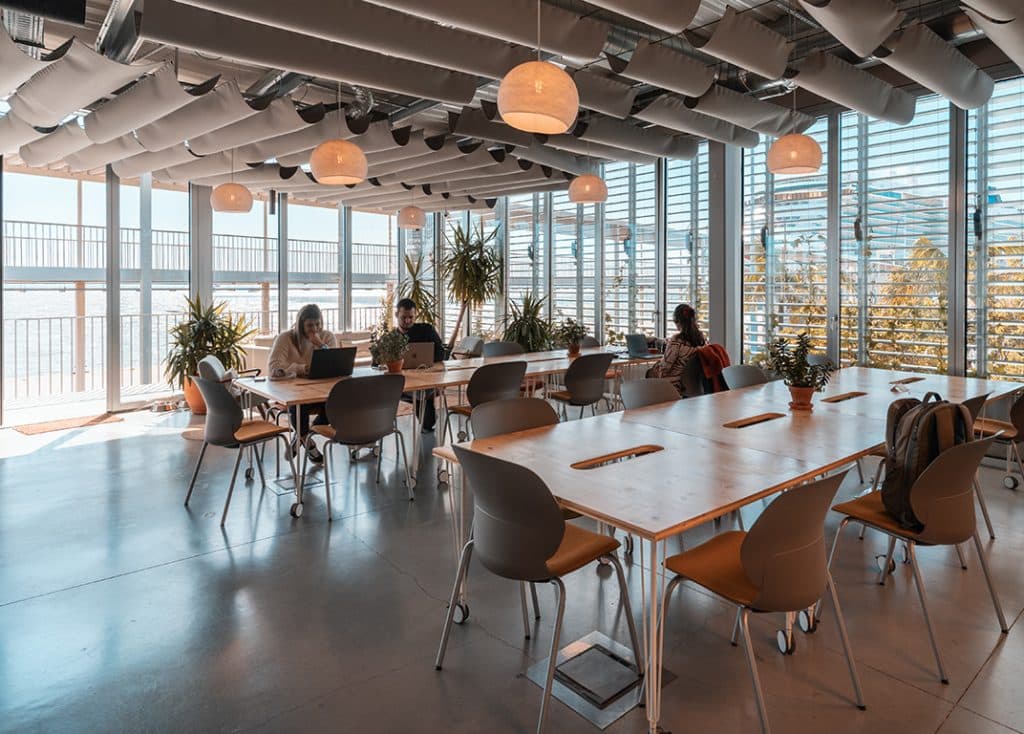
Alfama's coworking offer is shaped by its building stock: 15th–18th-century houses with narrow staircases, low ceilings, and limited Wi-Fi infrastructure. Operators here optimise for atmosphere over scale — small private rooms, terrace access, and the kind of address that makes visiting clients turn business meetings into weekend trips. Heden Workspaces' Santa Apolónia location near the train station is the pipeline-listed venue; smaller boutique operators dot the side lanes.
The neighbourhood doesn't function as a business district in the conventional sense. Coworking members are mostly freelancers, small creative studios, and remote employees of European companies who want a Lisbon experience that includes the historic core.
Metro: Santa Apolónia (Blue Line) at the eastern edge — terminus of the line, direct to Marquês de Pombal in 8 minutes.
Train: Santa Apolónia mainline station is one of Lisbon's two big rail terminals — direct trains north to Porto.
Tram 28: Climbs through Alfama on its way from Estrela to Graça. Iconic but slow.
Walking: Baixa 8 minutes west on the flat; the climb to São Jorge Castle is steep but rewarding.
It depends on the team. Daily-life logistics are challenging — narrow streets, limited parking, tourist crowds in summer — but the atmosphere can offset that for creative work. Most members who pick Alfama do so deliberately, not as a default.
Two reasons: the district sits on solid bedrock, which dampened the shockwaves that flattened the looser-soiled lower city; and its elevation protected it from the subsequent tsunami flooding. As a result, Alfama's streets still follow the original 8th-century Moorish layout — the only major part of Lisbon to do so.
Browse 1 workspaces, check prices, and book a day pass or office — no commitment needed.
Castelo de São Jorge — the Moorish fortress built in the mid-11th century, sitting at the top of the hill with one of the city's broadest panoramas.
Sé de Lisboa — the 12th-century cathedral, Lisbon's oldest church, built shortly after the 1147 Christian reconquest.
Museu do Fado — at Largo do Chafariz de Dentro, the formal home of Fado music.
Miradouro de Santa Luzia and Miradouro das Portas do Sol — the two most photographed Alfama viewpoints.
Santa Apolónia (Blue Line), the eastern terminus, at the foot of Alfama. Direct to Marquês de Pombal in 8 minutes.