//
Margareten Castle, the Margaretenhof, and dense 19th-century courtyards — workspaces in Vienna's residential 5. Bezirk.
The 5. Bezirk — Margareten — was separated from Wieden in 1861, formed from the former suburbs of Margareten, Hundsturm, Laurenzergrund, Matzleinsdorf, Nikolsdorf, Reinprechtsdorf and parts of Hungelbrunn. The district takes its name from the Schloss Margareten, first documented in 1373 as a farmhouse converted into a castle, destroyed in both Ottoman sieges (1529, 1683) and later rebuilt. The Margaretenhof — the imposing castle-like residential complex erected 1884–1885 on the former brewery site at the central Margaretenplatz — visually anchors the district as the symbolic successor to the old castle. Margareten today is dense, residential, and bürgerlich, with the Wienfluss and Mariahilf to the north, Wieden to the east, and the Gürtel to the west. Coworking is anchored by The Base at Margaretenstraße 70 — a 1200 m² space that opened as part of Vienna's wider startup-coworking wave.
Margareten's character comes from its 19th-century working-class density. The district was almost entirely built up between 1850 and 1900 with Gründerzeit courtyard tenements, many of which still function as residential blocks today. The Reinprechtsdorf area in the south-west of the district was a notorious working-class quarter through the early 20th century; the Margareten core around Margaretenplatz and the Schönbrunner Straße was always the more bürgerliche heart.
For coworking, that translates into a quieter, more affordable alternative to neighbouring Mariahilf or Wieden, with strong U4 and U6 access. The Base Margareten on Margaretenstraße 70 is the main pipeline-listed operator — a 1200 m² space serving freelancers, small studios and remote-first professionals. Members are typically Mariahilf or Wieden refugees who want lower rent at minimal commute distance.
Margareten's office economy is light and residential-adjacent — small consultancies, freelance design and architecture studios, and the Vienna home offices of European NGOs and policy-research organisations. The Schönbrunner Straße and Margaretenplatz host a steady mix of bistros and traditional Beisl for daily lunch coverage; for client meetings, members typically walk 5 minutes to the Naschmarkt or Mariahilfer Straße.
U-Bahn: Pilgramgasse (U4) at the northern edge, Margaretengürtel (U4) at the western edge, and Kettenbrückengasse (U4) at the Naschmarkt corner. The U6 runs along the Margaretengürtel for north-south access.
Tram + bus: Trams 1, 62 and the WLB Wiener Lokalbahn (Badner Bahn) serve the district along the Wiedner Hauptstraße / Eichenstraße corridor.
Walking: Mariahilf is 5 minutes north across the Naschmarkt; Wieden 5 minutes east; the Innere Stadt 12 minutes north-east; Wien Hauptbahnhof 10 minutes south-east.
Airport: Vienna International (VIE) is around 25 minutes via U4 to Wien Mitte and CAT.
Margaretenhof — the imposing castle-style residential complex erected 1884–1885 on the former brewery site at Margaretenplatz, the architectural symbol of the district.
Schloss Margareten — the original castle (first mentioned 1373), now surviving only in fragments after Ottoman destruction.
Margaretenkirche — the parish church on Margaretenplatz that gives the district its name.
Bruno-Kreisky-Park — the central park named after the long-serving Austrian Chancellor (1970–1983), who lived in the district.
Naschmarkt — Vienna's main open-air food market, on the northern boundary across the Wienzeile.
Margareten was separated from the 4. Bezirk Wieden in 1861, just eleven years after Vienna's 1850 incorporation of the suburbs. The split happened because Margareten had grown densely populated enough to function as its own administrative unit — and reshuffled the district numbering, which is why Mariahilf became the 6. Bezirk afterwards.
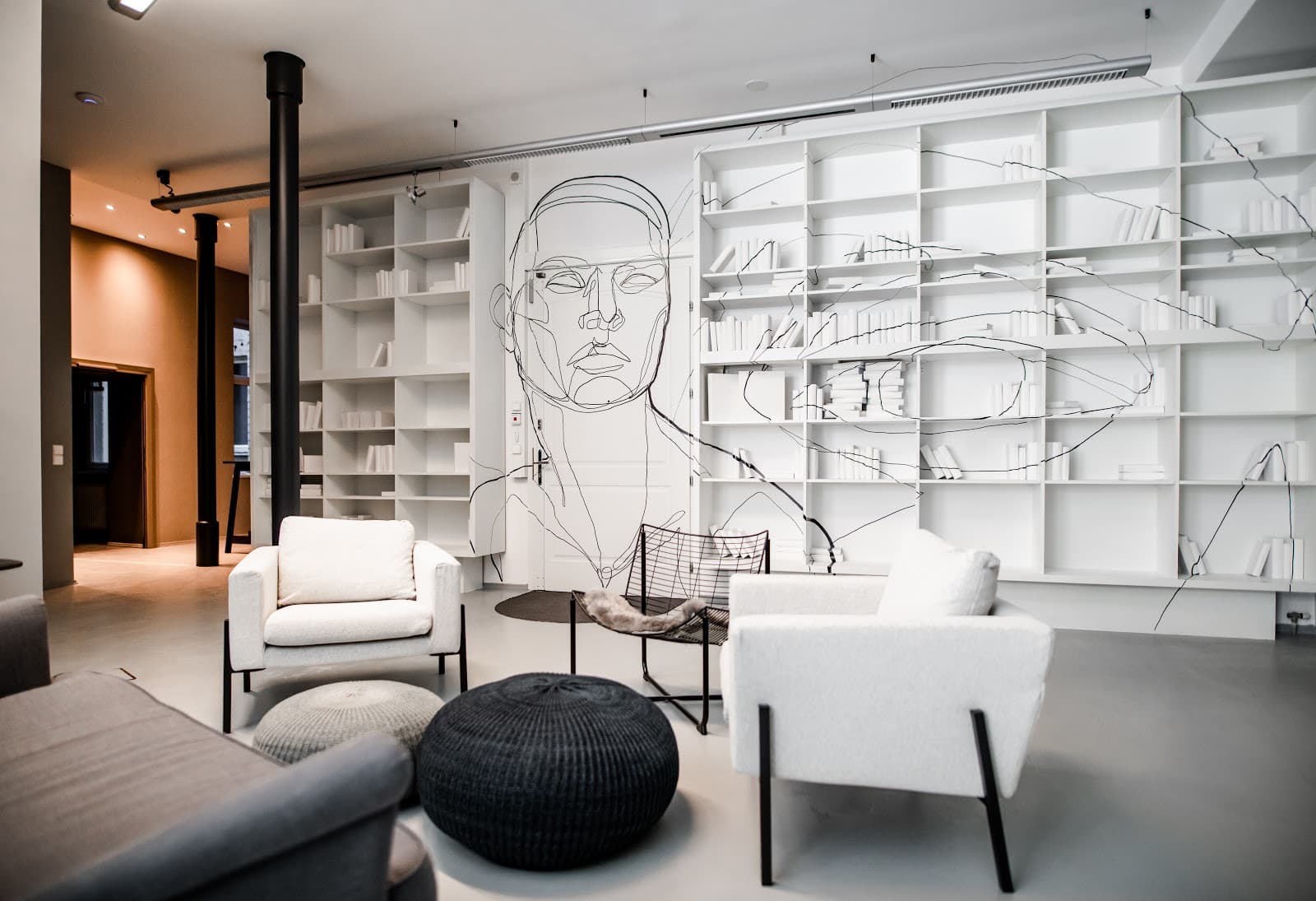
Margaretenstraße 70, near the Naschmarkt. The space spans about 1 200 m² and offers fully equipped workplaces alongside shared services — one of Vienna's mid-sized independent coworking operators.
Margareten is quieter, denser-residential, and notably more affordable. Mariahilf has the shopping street, the MQ and the pedestrian density. The two are 5 minutes apart across the Naschmarkt, so many Margareten members visit Mariahilf for lunch and clients but work in the calmer 5. Bezirk.
The imposing castle-style residential complex on Margaretenplatz, built 1884–1885 on the former brewery site that used to host Schloss Margareten. The Margaretenhof's facade still echoes the lost castle and gives the district its visual identity.
Browse 1 workspaces, check prices, and book a day pass or office — no commitment needed.